 Blog Blog
Please send us your comments
and let us know if we may publish them.
feedback@colorfulleadership.info
Denver Post
- Your Hub - July 13, 2017
Steve Wille presented to the South Denver Project Management
Institute (PMI) Roundtable project managers (PMs) on June 28,
2017. Regis University College of Business and Economics hosted
the roundtable at their Denver Technological Center campus.
Steve’s presentation titled Zero Sum Game, Agile Vs Waterfall;
exemplified how when PMs win a game of rock-paper-scissors their
opponent loses. He highlighted how zero sum games produce as
many losers as winners and picking a project management
methodology can be a zero sum game if they win at the expense of
others losing. His interactive presentation demonstrated that
as a project manager, when you pick one methodology over the
other, you lose the benefits of the method you did not pick.
Steve showed how to change the game from a zero sum, forced
choice, to an additive process where the real goal is to partner
with the product owners, deliver a superior product, and be
flexible within the constraints of the organization’s
standards. His session illustrated how some project
stakeholders know exactly what they want, when they want it, and
how much they are willing to pay. From the project manager,
they want a predictable, controlled project plan executed in a
sequential manner; seemingly preferring a waterfall
methodology. Other stakeholders on the same project don’t know
what they want, have no clue about cost and financial return,
and have a hard time staying focused on a distant goal such as a
delivery date. Sounds like they want a more agile project with
greater flexibility, and an opportunity to explore great new
ideas. Both types of people are on every project team. Steve
explained how PMs can accommodate both and must accommodate both
if they want sustained success.
Steve showed how to synthesize new methodologies from
traditional and emerging methods. More important, he revealed
how to sell new techniques to management and key stakeholders in
an additive, non-zero-sum way.
Steve Wille is an experienced information technology executive
at several large corporations. His book, Colorful Leadership,
looks at multiple dimensional leadership focusing in people,
process, and innovation. He has written and taught workshops on
project management, business analysis, and high performance
project teams. Steve is active in the Colorado IT community as
a board member of SIM (Society for Information Management,
president of RMIMA (Rocky Mountain Information Management
Association), and an active member of Mile High PMI (Project
Management Institute). He serves on the Regis University IT
advisory board. His MBA is from Regis University and his BSBA
is from the University of Denver. Steve is also a professional
photographer with a wedding photography business. His
presentations are graphically rich, drawing on his experience
with color and digital images.
The Regis South PMI Roundtable is an affiliate of the PMI Mile
High Chapter (pmimilehi.org), the tenth largest PMI chapter in
the world. PMI is the world's leading not-for-profit
professional membership association for the project, program and
portfolio management profession. Founded in 1969, PMI delivers
value for more than 2.9 million professionals working in nearly
every country in the world through global advocacy,
collaboration, education and research.
August, 2015, Press
Release
Steve Wille Presents
to Mile Hi Project Management Institute Roundtable
Steve Wille, IT
Executive and author of Colorful Leadership, presented to The
Lone Tree Project Management Institute (PMI) Roundtable, Regis
University hosted the event at their Denver Technological Center
campus. Steve is a former manager of software engineering,
Great-West Financial, Citigroup, and other corporations. He has
over 25 years of experience in corporate information technology
management. His article on Constructive Conflict has been
published internationally. Steve is a certified Project
Management Professional (PMP) and has developed multiple large
information technology systems from the ground up. Steve has an
MBA degree from Regis University and a BSBA degree from the
University of Denver.
Steve’s presentation on
“Harnessing the Power of Human Ingenuity” challenged attendees
to understand that is a mistake to think that past performance
assures future success. His interactive session illustrated
that while repeatable processes are at the core of successful
project management, managers must adapt to a rapidly changing
world. Steve’s workshop explored the three disciplines of
process, people and, ingenuity; and validated them through
evidence from historical studies. He recapped how the Hawthorne
studies caused a shift from scientific management to human
relations management in the early twentieth century. Steve
cited proof from these studies highlighting how researchers
learned that there is much more to productivity than finding the
one best way to do each task. People could mysteriously become
more or less productive regardless of the physical conditions.
The ingenuity discipline in Steve’s model traces its history
back to Edward Lorenz’s explanation of the butterfly effect
ushered in the era of complexity theory, also known as chaos
science. Steve demonstrated how to master all three disciplines,
so managers can think in three dimensions and act strategically
in any situation. He used his colorful leadership model where
three colors of light converge to form a full color picture on a
high definition television as a teaching tool.
The Lone Tree PMI
Roundtable is an affiliate of the PMI Mile High Chapter (pmimilehi.org),
the tenth largest PMI chapter in the world. PMI is the
world's leading not-for-profit professional membership
association for the project, program and portfolio management
profession. Founded in 1969, PMI delivers value for more than
2.9 million professionals working in nearly every country in the
world through global advocacy, collaboration, education and
research.
On Friday,
April 24, 2015, at 1:00 pm, I will be speaking at the Denver PMI
Project Management Symposium.
Harnessing the Power of
Human Ingenuity
By Steve Wille, PMP
Colorful Leadership
Web: www.colorfulleadership.info
The old management formulas such as continuous improvement and
best practices are of little help in an era of discontinuous and
disruptive innovation. The people and process skills that took
companies and individuals to their current levels of success may
not help as the world around them changes. To survive, leaders
and managers must move beyond best practices by inventing new
practices. This is why human ingenuity is of equal importance
with traditional management disciplines that focus on people and
process.
It is a mistake to think that past performance assures future
success. Process and people disciplines are at the core of
successful project management, but they are by no means
sufficient in a time when human ingenuity has become so
important. Ingenuity cannot be planned or controlled in
traditional ways.
In this workshop, each of the three disciplines, process, people
and ingenuity are explored and validated through historical
studies. There is a standard academic body of knowledge
supporting the people and process disciplines. This is traced
forward from the early twentieth century when scientific
management delivered gains in productivity that lifted the wages
and standard of living for people at all levels of society. The
Hawthorne studies are used to demonstrate the shift of
management studies into the human relations era. Through these
studies researchers learned that there was a great deal more to
productivity than finding the one best way to do each task.
People could mysteriously become more or less productive
regardless of the physical conditions. The ingenuity discipline
in our model traces its history back to Edward Lorenz’s
explanation of the butterfly effect which brought in the era of
complexity theory, also known as chaos science.
Our proposal is to master all three disciplines, so you can
think in three dimensions and act strategically in any
situation. This material will work both as a talk and as a
workshop. Steve Wille is an experienced conference speaker, as
well as a workshop facilitator.
Takeaway:
Respect, feedback, and team engagement are explored from the
three perspectives of process, people, and ingenuity. Each
perspective takes the leader in a different direction and the
art of successful project management is to do all three, even
when they appear to be in conflict. This workshop will offer
specific techniques for doing all three in any situation.
About Steve Wille:
Steve Wille, author of Colorful Leadership, is a manager of
software engineering, Great-West Financial. He has over 25 years
of experience in corporate information technology management.
Steve is a PMP and has developed multiple large information
technology systems from the ground up. Steve's MBA degree is
from Regis University in Denver, and his BSBA degree is from the
University of Denver.

On April 22, 2015, 10:30 am I will be
speaking at the Denver IT Summit.
http://www.theitsummit.com/event/denver-2015/
Over the
past 20 years, in addition to my day job as an information
technology manger, I have had the opportunity to speak at
technology conferences, write and teach project management
courses, and publish a book. The book,
Colorful Leadership, co-authored with Bill Kuehn and
Larry Nelson, was published in 2008. Since that time I
have worked with Dr. James Reardon on new material under the
same colorful leadership theme. Reardon is a professor of
management. We have self-published a
white
paper, Harnessing the Power of Human Ingenuity.
You are welcome to download this paper. If you want to use
it, please print the copyright information and the
www.colorfulleadership.info web source.
This paper
became the source of a keynote speech that I have presented at a
number of technology conferences. In 2014, I was the
keynote speaker
IT
Symposiums in Denver, San Antonio, and Salt Lake City.
I also spoke a the
Society of
Information Management (SIM) national conference in Denver
and the Minnesota SIM chapter in Minnesota. In 2105, I will
be speaking at the
IT Summit
in Denver and the
Project Management Institute Symposium in Denver.
After my
talks, I see book sales increase, but I feel bad that some of
the material in the keynote talk is not covered in the book.
Therefore, I am offering a free
download of
a summary of this talk, Harnessing the Power of Human
Ingenuity. Feel free to use it and please include
the copyright information if you print it. In addition, if
you are interested, you may view the
Youtube video:
Harnessing the Power of Human Ingenuity
Innovation: More is more. Try a lot of things and
something might work.
Quality: Less is more. Get focused and do something well.
People. Who is counting? Each interaction with each
person is a single human moment.
How many times have you heard from a successful person that if
he or she had known then what is known now, a lot of time and
money could have been saved and better invested. The thing
is, they did not know then what they know now and the only way
to have gotten to their success was by trying a lot of things
until something worked. Running in parallel with trying a
lot of things, you need to get focused on something and do it
well rather than doing things poorly. The thing is,
quality and innovation are independent and you must do both to
survive, with the hope you will thrive. In parallel with
that, is your relationship with the people around you.
People can help you and people can hurt you, depending on how
they feel about you. The answer? Do all three in
parallel, even thought and any given time only one of the three
is in play. It comes back to wearing the red, green, and
blue glasses, one at a time to get the whole picture. You
cannot stack the glasses because no light will travel through
all three filters. It is one at a time, with a reasonable
rotation to get the whole picture.
I will speak at the
Denver Southeast Rotary Club on
Thursday, June 7, 7:15am – 8:45am, at the Doubletree Hotel,
on Orchard just west of
I-25.
I found a low cost, high quality source of
photographs and clip art.
123RF Stock Photo
I
will be speaking at the
Rocky Mountain
Oracle Users Group (RMOUG) February 14-16, 2012 in Denver
Colorado.
Title:
Difficult Decisions
 Presentation
Summary: Presentation
Summary:
Most decisions
are easy and have very little long term consequences. Other
decisions are life changing and there is no going back. Picking
a technology platform is an example of a tough choice that locks
you in for the long term. Project managers often use a decision
matrix with numerical score to make process objective and
logical. This is essential, but not sufficient. The most
sophisticated decision engine is the neural network inside of
everyone’s head. It is good at fuzzy logic and pattern
recognition, telling us things we can’t see in a two-dimensional
decision matrix with a simple numeric score. A honeybee swarm
provides a model of how to make a life-changing decision by a
network of intelligent beings. If they pick the wrong location
for their next home, they won’t make it through the winter. Bees
travel a five-mile radius seeking out holes in trees, looking
for the perfect home. They return to the swarm and make a group
decision. Suddenly, thousands of bees fly together in one swarm
to their new hive. This session will present the honey bee
method for making important decisions using sophisticated
quantitative measurements combined with a group process that has
been perfected over millions of years.
Biographical Information:
Steve Wille,
author of "Colorful Leadership," is a senior applications
manager at Great-West Life and Annuity. He has over twenty-five
years of experience in corporate information technology
management. Steve is a PMP and has developed multiple large
information technology systems from the ground up. Steve's MBA
degree is from Regis University in Denver, and his BSBA degree
is from the University of Denver.
On February 14-16, I’ll be at the Colorado Convention
Center in Denver, Colorado for RMOUG’s
Training Days Conference.
This is the largest regional Oracle User Conference in North
America and attracts presenters from all around the country and
the globe. I’ll be presenting:
 Dr.
James Rairdon, a management professor, is collaborating
with me to produce an on-lined management class targeted
for project managers, but useful for anyone in a
leadership or management position. Jim is an
adjunct professor for several universities and does a
good deal of his teaching on-line. The name of our
class is, Turn On All the Lights. It
will be presented in ten minute modules designed to do
one per day. Dr.
James Rairdon, a management professor, is collaborating
with me to produce an on-lined management class targeted
for project managers, but useful for anyone in a
leadership or management position. Jim is an
adjunct professor for several universities and does a
good deal of his teaching on-line. The name of our
class is, Turn On All the Lights. It
will be presented in ten minute modules designed to do
one per day. |
Testing an online management and leadership class for project
managers, team leaders, and supervisors that will be published
by Construction Mastery
http://www.constructionmastery.com/
1. Intro
e-learning class
2.
Expectancy Theory
3.
Hierarchy of Needs
4.
In defense of
Bureaucracy
5.
Scientific
Management
If you found this and tried it, please let me know what you
think of it:
feedback@colorfulleadership.info
I am speaking at the
Annual
Rocky Mountain Project Management Symposium
Friday, April 22, 2011 Colorado
Convention Center, Denver

The New Normal in Project Management -
Work Harder, Faster, and Smarter
It’s a tough
economy and to survive you have to do more with less. Once you
figure that out, and put forth the effort to make it happen, the
job can be a lot more fun. We will examine specific techniques
for working faster, based on the book, Colorful Leadership.
It’s all about process, people, and embracing innovation. We
pick up were PMBOK leaves off. A must attend session for
project managers that want to survive in the 2nd
decade of the 21st century.
Steve Wille PMP, author of Colorful
Leadership, has over 25 years senior level experience in
corporate computer technology management. In 2002 he took a 3
year sabbatical to write, and to teach classes on leadership for
project managers. He now works at Great-West Life where he is a
senior IT manager. Steve's MBA degree is from Regis University
in Denver, and his BSBA degree is from the University of Denver.
He is also a wedding photographer with his daughter and he drew
on his experience with digital photography as the model for this
colorful book. Steve and his wife, Joanne, live in Centennial
Colorado.
I am speaking at the
3rd Annual Colorado IT Symposium Thursday April
28, 2011 Denver Marriott Tech Center

| 10:45 am |
New Normal
- Information Technology Re-invention
|
| Room |
Steven Wille
Senior Applications Manager
Great-West Life
Things have changed and they are not going back. We
need to adjust to the new reality. Numerous jobs are
gone, replaced by better and faster technology.
Maybe your old job is gone, too. As technology
workers, we must reinvent our careers, investing
time in future technology to avoid the next wave of
layoffs. How do you find the new normal and prepare
for the future? No one can predict the future, but
you can see patterns and these patterns will repeat
many times over. This presentation will use a model
that traces a technology from its inception, through
market acceptance, to commodity, obsolescence and
the discard pile of bits in the bucket. This model
applies to your products, your technology, and your
career.
|
I am speaking at the
Rocky Mountain Oracle Users Group Training Days
February 15 - 17, 2011
Steven Wille,
Great-West Life
New Normal - Information
Technology Re-invention
Things have changed and they are not going back. The economic
crash drove productivity up because corporate survival required
efficiency. Technology accelerated the change and made it
permanent. You need to adjust to the new reality. Numerous jobs
are gone, replaced by better and faster technology. Maybe your
old job is gone, too. As technology workers, you must reinvent
your careers, investing time in future technology, if you want
to avoid being in the next wave of layoffs. Current trends are
toward open source, along with the proprietary Microsoft tools,
along with pie in the sky technologies like cloud computing. How
about Android, Google Office, and Open Office? Will this
continue? How do you find the new normal and prepare for the
future? No one can predict the future, but you can see patterns.
If you look at the present situation from several perspectives,
you can get a clearer picture and make better decisions. This
presentation will use a model that traces a technology from its
inception, through market acceptance, to old commodity, on its
way to obsolete and forgotten. This model applies to your
products, your technology, and your career.
Steve Wille, author of Colorful
Leadership, is a senior applications manager at Great-West
Life and Annuity. He has over twenty-five years of experience in
corporate information technology management. Steve is a PMP and
has developed multiple large information technology systems from
the ground up. Steve's MBA degree is from Regis University in
Denver, and his BSBA degree is from the University of Denver.
Read the recent interview
with Leadership Guide Magazine

Leadership Guide Magazine
Editor Linda Hatcher interviewed Steve Wille, a leadership
lecturer, writer and management expert, about his unique
perspective on leadership as fully detailed in his book Colorful
Leadership.
I will be the panel moderator at the RMIMA-SIM joint meeting on
June 15. www.rmima.org
My book is in its third printing, and I
have a new publisher. The inside content has not changed.
I was able to lower the price because my costs are lower.
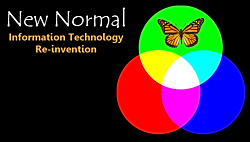 New
Normal - SIM meeting March 16, 2010 New
Normal - SIM meeting March 16, 2010
I had people personally come up to me
after the meeting to complement your program and energy. Several
mentioned that the "tension" between microsoft and other options is
great for discussion because in the work place - people don't get to do
that as much... Great job. Thank you. Stacey
On March 16, 2010, I will be speaking at the Society of
Information Managers (SIM). This is a new topic where I am
applying key principles in the book to technology. The talk is
titled, New Normal - Information Technology
Reinvention
January 14, 2010,
I spoke at the National Association
of Women in Construction, a group of interesting people with interesting
jobs. Some of them gave me permission to quote their evaluations
on my blog. One woman, Tarah Harpstreith, said, "I think it is
logical and I can't wait to use it. I am not a touch feely person
so I will try using the filter." She was speaking of looking
through the people/feeling filter in addition to the more logical
security/quality filter. What was interesting to me was that the
participants were all women who found themselves in professions
dominated by men. I enjoyed hearing their perspectives on how to
use the material in my book.
November 16, 2009
Steve,
Once again, THANK YOU for taking the time to
share your presentation on Colorful Leadership with the Jeppesen
Project Management Community of Practice.
I have had numerous positive comments on the presentation and the
approach to viewing our "people", future and security/quality filters.
I look forward to taking the assessment as well.
Again, thank you!
Pamela M. Benda, PMP
November 13, 2009
I just spoke at a PMI roundtable at Jeppesen, the
company that creates the maps used by airline pilots throughout the
world. I had no idea how big this operation is, and how long it
has been in Denver. It was a real honor to talk to project
managers at such a great company.
October 23, 2009
Last week I spoke at the Project Management Institute
(PMI). One of the people in attendance, Dan Rondinelli, contacted
to meet for coffee at Starbucks. Dan bought the book after hearing
the talk and he wanted to discuss it. When we met he spoke
favorably of the book, so I asked him if there was any one thing that
came through. He replied, "Looking for the 3rd choice can make all
the difference. We try to make things black and white when it
isn't. It is nice to find a 3rd choice." Dan also commented
on our filtered view of Maslow's hierarchy of needs. He said we
take a unique approach by saying all the needs are there all the time.
Steve
 Wednesday, April 29, 2009 - 5:30
p.m. Wednesday, April 29, 2009 - 5:30
p.m.
Corporate Culture and Conflict
Corporate Culture can be defined as the values,
beliefs, assumptions, and symbols that make up individual and collective
conceptions of what an organization is all about. On both individual and
collective levels, our perceptions of corporate culture tell us who we
are, what we're doing here, and why we're doing it. And as we all know,
behind the seemingly smooth facade that the corporation strives to
present to the world, there are lots of incompatible ideas about how
corporate realities should manifest themselves, and thus lots of
underlying conflict.
We don't go to work for the culture and conflict. We
go to work to get things done. Corporate culture and conflict are
background processes, always influencing everything going on, but
usually unrecognized. Our goal is to carefully observe what is really
happening in the background and then taking a strategic approach to the
situation rather than slamming into it mindlessly.
We will use the 3-Filters discipline from the book,
Colorful Leadership, to see through our blind spots. We will
then develop three distinct options for what to do about it. Finally we
will chart course of action that incorporates elements from all three
approaches. This sounds like it could be a lot of work, but it is quite
simple once you grasp the concepts and understand why this approach
greatly enhances your ultimate chance of success.
April 17, 2009
I have to echo
Suzanne’s comments.
Elaine
Elaine W. Miller
Thanks again for donating two of your
Colorful Leadership books to our AITP meeting. We gave you
lots of credit, and told everyone what a great book it is. Others
chimed in and agreed. Also, I had a couple of your flyers, and put them
on the tables. I think you received much PR from your act of
generosity.
Suzanne
April 08, 2009
Steve:
Thank you very much for
recommending your book!
First, I discovered that you
and I have quite a bit in common, most notably our similar experiences
in the post-9/11 economic crash. My parachutes, unfortunately, didn't
work, and I bounced when I hit. I was wondering if this book, or the
research that went into it, started for you around 2002. You don't
mention in the preface exactly when you met Larry Nelson, but I can well
imagine how researching and writing a book would have been important at
such a trying time.
Second, the instant I read
the heading "Future Filter" on p. 15 my inner voice said: "Oh, that's
hope!" At mid-page, you write: "When looking through the future
filter, you can give up any hope of building a yesterday and instead
focus on tomorrow." My interpretation may surprise you, and I'd like
your thoughts - here it is - the future filter represents personal hope
in the forward direction, and that's what motivates us. It's not so hard
to understand when you consider that the loss of hope results
in personal and professional stagnation and, most drastically, personal
depression. Loss of hope (or destruction of the future filter,
if you will) is the negation of life as it should be. Hope is essential
for human survival, as you so correctly point out, but I don't really
need chaos theory or economics to understand this.
Your book is very easy to
read. In fact, I think it is a thoughtful and practical presentation of
what other authors have made into ponderous theories. Nicely done!
Best regards,
David
February 16, 2009
I recently had the pleasure of reading your recent book,
Colorful Leadership. I found it to be very easy to read for
three reasons: 1) the warm, "let me talk to you like a good friend"
style of writing; 2) the organization; and 3) the font type and size.
A perfect example of the first reason is the use of the
word "Bummer" on the back cover; that really sets the tone of the whole
book. Other examples include the use of personal experiences to help
explain a concept. Of course, the use of photography and television
analogies really helps to explain the filter concept.
The topics are organized in a natural, meaningful flow,
where each chapter builds on the previous one. I especially like the
final chapters, "Unified Theory" and "Summary" which tie everything
together. Like a speech: tell them what you're going to tell them, tell
them, and tell them what you told them!
Suzanne I. Weston, Weston Consulting, Inc.
Rocky
Mountain Information Management Association
www.rmima.org

Thursday, February 12, 2009
10:30 Registration
11:00 Panel
12:00 Lunch
Hotel VQ by the stadium
Corporate Culture
Survive and Thrive the First 100 Days and Every
Day Thereafter, Even in a Bad Economy
Steve Wille -
Author, Colorful Leadership
Do you think your
organization is going in the right direction? Do you sometimes feel out
of sync with the corporate culture? Like it or not, you have to play
the hand you are dealt. If you want to survive and thrive in any
organization you need to play your cards strategically. Pick your
direction and go for it, but avoid unnecessary battles that could end
your career. Along the way pay attention to how the people around you
feel about what you are doing. Will they be with you or against you?
This presentation is
based on the new book,
Colorful Leadership. We will take a disciplined approach
in assessing a situation from three perspectives to build a complete
image of the current reality. Next, we will examine our choice of
action. Sometimes a passive, wait
and see approach is the best strategy. Other time a much
more aggressive, make it happen
approach offers the biggest payback. Either way, it has to be
constructive if you want something good to come out of it.
Benefits:
-
Learn how to
rapidly assess a situation,
-
Practice finding
at least three alternative courses of action.
-
Think
strategically and focus on the future when choosing the best
alternative.
This will be an
interactive session with an opportunity to observe a situation and
practice the skills.
Steve Wille is a
senior applications manager at Great-West Life & Annuity. He has over
25 years experience in corporate technology management. His article on
Constructive Conflict has
been published internationally and his most recent book,
Colorful Leadership, was
published in 2008.
What I learned from reading my book
There is an old saying that if your really want to
learn something, teach it. Now that the book is written and
published, it is an artifact that I can use as a resource. Having
lead some training sessions, I have learned what the book is really
about. It is about finding the sweet spot where Quality,
Innovation, and People's Feelings intersect. It is not
about compromise where you short change each item to find the lowest
common denominator. To lead a successful organization you must pay
constant attention to all three perspectives all the time, with maximum
effort on all three fronts. It is about convergence, not
compromise.
Another interesting thing I discovered while
preparing for the workshop is the difference between two and three
choices. When you have only two choices, you often focus on the
differences and choose the least bad option. When you have three
choices, you tend to find areas of overlap and agreement. The
rule of three is, "When you have two choices, find a third option."
January 1, 2009 - Happy New Year!
Project Management Institute (PMI) Workshop
December 13, 2008,
I was surprised to see 55 people show up on a
Saturday for a half-day class on my book. They actually paid money
to hear me talk on a day they could have been out shopping. PMI
does classes monthly so project manager with the PMP designation can get
their continuing education credits. I was told that we had an
unusually strong attendance for the class. Here is what they had
written as the workshop description:
Weak project mangers complain about accountability without
authority. Powerful project managers get things done by looking
beyond authority, seeing the world as it really is. Colorful
Leadership offers a disciplined approach to viewing a situation
through three filters and managing a project appropriately from
three perspectives: People, Quality, and Innovation.
How You Will Benefit
It does no good to look at the world through rose colored glasses,
unless you also look through other colors, too. We call this
spinning the filters. How people feel is important, but no more
important than how they are doing against plan, or how they are
adapting in the face of uncertainty. The value of a disciplined
approach for spinning the filters is you see a complete picture and
make the best decision to increase your chance of success.
Topics covered:
* People Filter - dealing with perceptions and feelings.
* Quality Filter – repeatable processes that work regardless of how
people feel.
* Future Filter - adapting to uncertain conditions.
* 3-Filter Blindness - discovering your area of leadershipblindness.
* Automatic color balance – adapting to the current situation.
* Trump – a strategy for when you are out of sync with the corporate
culture.
* Out of control situations – what good can come from this?
This workshop is based on the new book, Colorful Leadership, and
is presented by the author, Steve Wille. The book is available on
Amazon.com and additional information is available at
www.colorfulleadedrship.info.
Presenter: Steve Wille
Location Regis University
The participant evaluations are available
for your entertainment and review.
Royalty Check
I received a royalty check from books sales on
Amazon.com. I guess they actually sold some books.
CPEx - Colorado
Performance Excellence
Yesterday, I attended the CPEx Quest for Excellence VII, where
Colorado organizations were recognized for performance excellence based
on Baldrige criteria.
Two of the education sessions I attended caught my attention:
- “Innovation in Process
Management — Lean Six Sigma and Malcolm Baldrige”
Leon Spackman, PMC Solutions
-
“Organization Creativity, Disney Style” -
David Mulvey, The Disney
Institute
When I think of Baldrige, Six Sigma
and process management, I do not think of organizational creativity.
Process management is about driving out variation while creativity is
about introducing variation. When an organization focuses on one,
it is often to the exclusion of the other. I was quite pleased to
see both topics addressed in one conference, and neither was watered
down to accommodate the other. This is what Colorful Leadership
is all about. Fully explore each perspective and then do both.
Process excellence without innovation leads to stagnation and
diminishing returns. Innovation without process excellence leads
to interesting ideas that will not survive the test of reality.
The Disney presentation was
particularly interesting. I have heard the term Imagineering
before, but I never really thought about it. It is the
blending of imagination and engineering. It takes great
engineering to bring the the great creative ideas to life. It
takes incredible and playful creativity to think of the ideas that are
worth brining to life. The magic of Disney is both process
excellence and innovation. All they while their focus is on the
customer, defined as anyone, any age, from anywhere. This sounds
like the 3-Filters in Colorful Leadership, People-Feelings,
Quality-Security, and Innovation-Future.
At the conference I ran into Cheryl
White, author of Change on Demand. As we were listening to
the Disney presentation, she wrote me a note that the creativity tools
would never fly at a bank or insurance company. I thought about it
and agreed that culture plays an important role in how you roll out
Imagineering. In a financial institution, quality trumps
creativity. Bank customers want accuracy and security, not fun and
games. On the other hand, banks do need to keep up with technology
and adapt to the changing economy. There is need for innovation,
but it will always be trumped by quality. This means the creative
people have to act strategically when they play their cards.
Innovation needs to live within the context of the organization's
culture and goals.
 For
more information on CPEx
contact Tom Mauro, CEO, at
303-893-CPEx (2739)
www.coloradoexcellence.org For
more information on CPEx
contact Tom Mauro, CEO, at
303-893-CPEx (2739)
www.coloradoexcellence.org
Steve Wille, November 8, 2008
Workforce Filters
Blindness and Transparency at Work
Today, I met with Rina Delmonico, a leader in the
Colorado technology community, and she asked me how this book applies to
everyday work, regardless of your position in the organization.
We
got into the topic of filter blindness. It is normal to think that
everyone sees exactly what you see. Unfortunately, it is not that
way. Due to your filters, you can be blind to critical information
that others see clearly. Compounding the problem, this blindness
causes you to neglect to address items that others see as important and
urgent. Such items can be dark shadows that make no sense to you.
Most blockages to effective communications are unintentional. We
are totally unaware of them because we get used to seeing the world
through colored glasses.
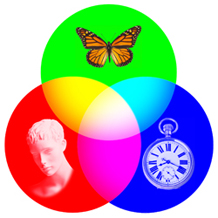
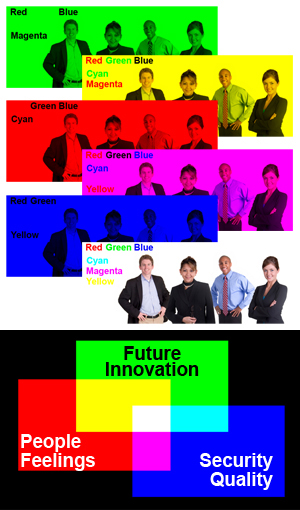
Take a look at the pictures on the left. If
you were wearing green glasses, you would see the top image.
Notice that the words red and blue are dark shadows and you cannot tell
what color should be there. If you remove the green glasses and
look through red, remembering what you saw through the green, you would
effectively see both red and green which gives you the yellow image.
The word blue is still a
mysterious dark shadow. The only way to see the complete picture
is to take off the red glasses and look through blue, remembering what
you saw through green and red. This is how a DLP computer
projector works. A white light shines through a set of spinning
filters, creating red, green and blue images in rapid succession.
You quickly assemble the three distinct images in your mind and see full
color.
The way to achieve transparency is to
spin the filters. You do this by paying attention
to people, quality, and innovation, one filter at a time. After you spin the
filters to see what others are seeing, turn on the automatic color
balance in your brain to adjust for other people's filters as you talk
to them.
Transparency is about seeing the complete picture,
and then addressing it in your communications. All of your communications
need to be 3-Filters compliant if you want others to see the complete
pictures.
Steve Wille, October 17, 2008
|
Politics, Mathematics and Chaos in the Economy
Understanding the September, 2008, economic meltdown, and how to
deal with it.
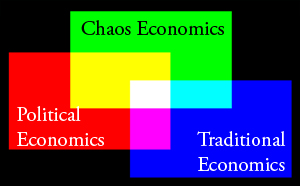
In chapter 6 of Colorful Leadership, I used
economic theory to illustrate how you can explain something three ways,
all of them right.
Political Economics
From a political point of view you see political causes and political
opportunity. If you are a socialist, the financial collapse is a
clear case point on what is wrong with capitalism. The solution is more
government regulation and oversight. If you are libertarian, you
probably want the government to stay of it and let the market correct
itself. If you are running for office, it is useful to cast blame on
the other party.
Traditional Economics
Economists explain the problem in terms of supply and demand, along with
expectations of the market. The solution is to support the market
and soften the blow so the market can correct itself. Once
confidence is restored the market will return to normal patterns.
Mathematical models help economists find trends, and we all want to
accurately predict the future based on these trends.
Chaos Economics
There has always been boom and bust. There is no stability and no
equilibrium. Whatever pattern is in play, it will continue with an
amplified effect until something changes and the pattern reverses.
The market is like a herd of animals. You never know where they
might go, but you can count on them to stay together. They might
move slowly and they might stampede, leaving nothing standing in their
path. Give up on stability and control, and develop a strategy for
surviving boom and bust economics. Watch out for the herd as you
make your decisions. The amplification principle tells us
that small changes can make big differences.
Which is right?
They are all right at the same time. What should be done?
Look through all three filters and try to understand them all.
Only then, can you make an informed decision and develop the best
strategy for dealing with the current reality.
Steve Wille, September 29, 2008
9/30/2008
Subject: Re: Chaos Economics
Oh how right you are, an oh how libertarian I
am. I have a Bob Barr bumper sticker on my car now.
Mike
9/30/2008
Hi Steve: Thanks for giving me an opportunity to
respond to your thought provoking blog. I must admit that I really
struggled as I created my response. So let me know if my comments make
any sense.
The following addresses the question "What can be
done?" rather than the "interpretive reasoning" discussion which is your
area of expertise. As you read this, please overlook the lack of
examples at this point. So much study has been conducted on this
subject, but much of it is colored by "lessons of history". I am
reluctant to color the validity of my comments by including examples
taken from a "fallen enemy"
Studies conducted right after WWII examine social
shaping mechanisms in detail. Ellule's book on propaganda, (while
sociological rather than mathematical) summarizes key findings on the
subject. These studies suggest that achieving desired social behaviors
requires careful manipulation of the group--as an integrated
social-system!!! (I can only imagine what Ellule could have discovered
had he had the ability to apply our current mathematical modeling tools
to these data.)
Since the war, scientists have discovered that
social systems, including the Market and politics, are the outcomes of
the behavior of complex adaptive systems. The promise of chaos and
complexity theory is that the behavior of even large social systems can
be regulated. The “twin” sciences tell us that social systems are ideal
candidates for oversight and control because they are programmable
systems. Insights from science can also assist us in determining how
this reprogramming can be accomplished.
While it is true that at times social systems
behave at times like migrating wildebeests--carrying people along with
them, science suggests that we can reprogram these systems if the right
amount of energy is applied to the system at the right place and at the
right time. The secret is to know precisely how much change is possible
at one time, how much energy to apply, and where to apply it. Using
sound scientific techniques, a knowledgeable practitioner can set
tolerances on, and provide governance over the self-regulating
mechanisms inherent in wildly oscillating social systems.
The Science of Change, which is really a number of
sciences that offer a set of tools for regulating social (mis)behavior,
sits at the intersection of the primary colors. While offering us
virtually no information on how to control the behavior of any
individual within a group (the last being the domain of psychology and
largely irrelevant to the motivation of "group mind"), this “New
Science” tells us precisely how to reshape and direct the behavior of
groups as complex adaptive systems.
In change capable hands, tools based on the Science
of Change promote “good” outcomes by proactively maneuvering society
(including societal sub-systems such as the Market and politics) in a
socially responsible, fiscally sound direction--something that our
present state of learned helplessness and passive watchfulness does not
allow.
Unfortunately, these tools can be used just as
readily to promote evil or socially irresponsible results. The tools,
like atomic energy, are amoral in and of themselves. It is the tool user
who determines the ethical nature of the outcome.
 I agree with you that each filter has value in
understanding a political situation. Because of the volatile nature of
social situations, however, filters can only expose "the truth" that
lies within the “current range of possible behaviors". As the range of
possible behaviors shifts, so does the implicit "truth" of the
situation. I agree with you that each filter has value in
understanding a political situation. Because of the volatile nature of
social situations, however, filters can only expose "the truth" that
lies within the “current range of possible behaviors". As the range of
possible behaviors shifts, so does the implicit "truth" of the
situation.
The white light shines where scientific principles
underscoring each primary sector overlap in a single, unified theory for
creating measurable social change. This light illuminates a range of
behavior probabilities (probable truths if you will) from which to build
a cohesive strategy that embraces all the philosophies of politics in
all colors of light.
Cheryl White
Executive Partner
Change Delivery Group
http://www.changeperfect.com/
Keynote: Corporate Culture and Conflict
Steve Wille - Author, Colorful Leadership
Do you think your
organization is going in the right direction? Do you sometimes feel out
of sync with the corporate culture? Like it or not, you have to play
the hand you are dealt. If you want to survive and thrive in any
organization you need to play your cards strategically. Pick your
direction and go for it, but avoid unnecessary battles that could end
your career. Along the way pay attention to the people around you.
Will they be with you or against you?
This presentation is
based on the new book, Colorful
Leadership. We will take a disciplined approach in assessing
a situation from three perspectives to build a complete image of the
current reality. Next, we will examine our choice of action. Sometimes
a passive, wait and see
approach is the best strategy. Other time a much more aggressive,
make it happen approach
offers the biggest payback. Either way, it has to be constructive if
you want something good to come out of it.
Benefits:
-
Learn how to
rapidly assess a situation, even at the height of conflict.
-
Practice finding
at least three alternative courses of action.
-
Think
strategically and focus on the future when choosing the best
alternative.
This will be an
interactive session with an opportunity to observe a situation and
practice the skills.
Steve Wille is a
senior applications manager at Great-West Life & Annuity. He has over
25 years experience in corporate technology management. His article on
Constructive Conflict has
been published internationally and his most recent book,
Colorful Leadership, was
published in 2008.
Steve Wille,
September, 25, 2008
9/30/2008
Hi Wille,
Looks
GREAT! We are really looking forward to this and thanks so much for
doing it. Is March 19th still good for you?
Thanks
Randy
http://www.denveraitp.org/

NOTE: Steve Wille will be the keynote speaker at AITP on March 19.
See my proposed talk above.
-
5:30 Networking / Attitude Adjustment (Cash
Bar)
-
5:45 Workshop - see Below
-
6:55 Dinner: (vegetarian on request)
-
7:25 Business Meeting & Announcements
-
7:35 Keynote - see Below
Register at:
http://www.denveraitp.org/
Understanding the center by walking on the edges.
Last night I was at the Society of Information Managers (SIM) and was
asked what this book was all about. I looked at the triangle on
the cover and pointed out that the only part of the photograph with
natural color was in the center where the colors on the edges converge
to form one complete picture. The book is about understanding and
living in the center by walking on the edges. To understand what
other people see, you need to look through their eyes. Each person
sees an image that is accurate, but incomplete. If I put on red
colored glasses everything looks red, but I can still see what is out
there. The red image is accurate, but incomplete. The same
would be true with blue and green glasses. By spinning the filters
I build the complete picture in my mind, even though I am actually
seeing three distinctly different images, one at a time.
Your color television works by displaying three images on the screen,
each shot through a colored filter in the camera. The red,
green, and blue component images exist as colored dots, side by side.
If you turned off one or two of the colors on the TV, the picture would
look like one of the sections of the triangle on the cover of my book.
I built this triangle a section at a time by turning off colors in
Photoshop. The center triangle, of course, had all three colors
turned on.
When you assess a situation, take the time to spin the filters.
Spin them slowly so you can understand each perspective.
-
When looking through the people
filter, pay attention to feelings. Feelings are reality to
each person. To be an effective leader you must anticipate the
feelings of others. To understand feelings, you must turn off
the logic filter for a short time.
-
When looking through the security
filter, turn off the people filter and take a cold hearted view of
reality. How I feel about a situation does not change the
reality. If there is bad stuff out there I must protect
myself. If the quality of my product is bad, I need to do
something about it, regardless of how I feel about it. To
sustain an organization that I manage, I must build processes that
work regardless of the people doing the work.
-
When looking through the future
filter, forget logic and forget feelings. Instead, look at
possibilities. Don't limit your possibilities by staying tied
to the past, filtering out everything inconsistent with what you
know to be true. Don't pay attention to your initial feelings
as you explore new ideas.
After spinning the filters to see a more complete images, make your
decision and go where you decide to go.
Steve Wille, September 23, 2008
 We
were interviewed on Talk Internet, W3W3 We
were interviewed on Talk Internet, W3W3
Steve, Bill, Larry,
August 12, 2008
Listen
to the Colorful Leadership interview: Skill Set for All Leaders, All the Time
We now live and
operate at Web speed. The five year plan is out. If you can plan ahead
for five quarters, you're doing well. We must produce more with less.
Steve Wille and Bill Kuehn, partners of Tough Teams are also co-authors
of Colorful Leadership along with Larry Nelson. When it comes to
Leaders, Managers and Entrepreneurs Steve always asks, "Are you looking
at the world through rose colored glasses?" Listen to their discussion
as it will give specific how-to ideas that can be used right away. Past
frustrations will be understood and then dissipated. You will be able to
win with any boss, sell more ideas, and get results that exceed
expectations. Simply stated, we all see the world through three filters
- future, people, and security. We prefer to communicate with one
filter. This means, if we communicate through the future filter only
people with the exact same filter will receive our message with clarity.
To attain total clarity, we must communicate through all three filters
all of the time. This also explains why we don't understand other people
the way we really want to. If they don’t communicate in our preferred
filter we will be confused. Every communication needs to be 3-Filters™
compliant, and there are three simple questions to ask in any situation.
1- What do you think? 2- How do you feel about it? 3- Where can this go?
Listen for some great ideas for all Leaders.
Related
Links:
Colorful Leadership ||
Tough Teams ||
3-Filters Technology™ ||
Amazon ||
Keywords: Steve
Wille, Bill Kuehn, Colorful Leadership, 3-Filters Technology™, Tough
Teams, Leaders, Total Clarity, Communicate - Bytes: 11125240
LISTEN 8/18/08
Good Morning Steve,
First, thank you for
letting me read your soon to be published book
Colorful Leadership. I
found that once I had the time to sit and read the book without any
distractions, I could not put the book down! That is rare for me when
it comes to these types of books. I always enjoy reading books related
to this subject, but yours was an easy read and I found that it relates
to the reader on a ‘personal level’, therefore making the reader not
wanting to put the book down.
The material is well
organized and easy to understand. Direct and to the point. The content
is very clear – no ‘fluff’ to fill up pages. All information that can
be used and practiced easily. I made notes in the manuscript you gave
me – hopefully in a way you can find quickly and address (or
ignore…….). My notes are more towards editing and not the content of
the material – as I was able to read the book – understanding exactly
what your intent was. It was very clear to me. Not confusing or ever
leaving me with the feeling of ‘who cares’. I always wanted to turn the
page to see what was next. Again, unusual for me.
So many times when you
read a book on related matter as yours, you end up skipping sections
because you can’t relate to what is being said or understand why it was
there in the first place. Or you just say, who cares?
I can’t wait for you
to place on Amazon.com so I can purchase my own copy – and also start
planning on who else I am going to buy a copy for as well. Thank you again for
this opportunity. I truly enjoyed it.
Elliott Morgan
7/26/2008
I am seeing myself in a different light. The biggest mistake I can
make is to think that others think the way I think.
This speaks to people at all levels. I understand better how my
managers think and feel. This would help them to understand my
thinking. It is not left brain vs. right brain. It is whole brain.
Patty McCully
7/26/2008 |