|
 Harnessing
the Power of Human Ingenuity Harnessing
the Power of Human Ingenuity
Every day the game changes because somebody, somewhere, is
inventing the next new thing. People are naturally clever and
adaptive but our need for order and control can shut down any
human ingenuity. There is a way to
have it both ways. You can have order and you can have
ingenuity.
For more information
about this keynote talk call us
at 720-934-7667 or send email to
steve.wille@ColorfulLeadership.info
The 3 Great Agile Challenges:
When you introduce agile to your organization, keep in mind three essential differences that must be respected. You will move from sequential to random timing. Teamwork will move from alignment to collaboration. Scope will move from exact requirements to a prioritized open backlog. This will create some challenges for people used to the waterfall culture. To get the full benefits of agile you must embrace these differences.
White Paper: Simplicity Complexity and Compromise
Simple answers to complex problems are often wrong, but useful
White Paper: Mashup of waterfall, agile, and lean project managmeent
White Paper:
Zero Sum
Games, Agile Vs. Waterfall
YouTube recording of this presentation from
Mile High PMI Symposium 2017
White Paper:
Agile, Waterfall, and
Lean: Emerging Trends in Project Management
Short Video:
Who is
Steve Wille and why should I care?
Video:
Think Fast, Act Faster - Management and leadership in the Agile
World
White Paper:
Think Fast, Act Faster -
Management and Leadership in the Agile World
Video:
Harnessing the Power of Human Ingenuity
White Paper:
Harnessing the Power of Human Ingenuity
Book:
Colorful Leadership
Article in the Denver Post regarding PMI Roundtable event
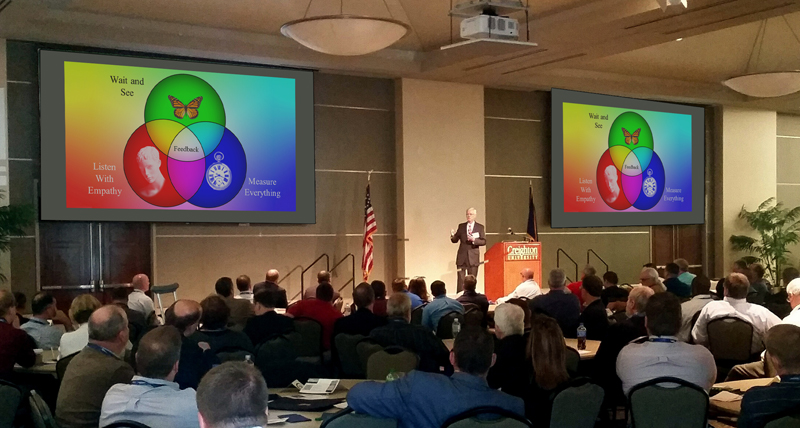
Steve Wille at
IT Symposium, Creighton University, Omaha, Nebraska
Steve Wille has delivered keynote speeches
for our IT Symposium series in Denver, San Antonio, Salt Lake
City, and Omaha. Not only does Steve deliver high-quality
content- he does it in an entertaining and thought-provoking
way. As a company that solely produces IT events, we know that
the content and quality of speakers is what ultimately what
keeps people coming back year after year, which is why Steve has
spoken in several of our events. A quick scan over the audience
while Steve is speaking shows a captivated audience, never
preoccupied with their cell phones, tablets or laptops- we
attribute that to the level of speaker that he is. Steve’s
leadership presentation always provides actionable information
that you can take to your organization, and any executive in any
role would be better off for hearing his message.
Jeff Hinds
EFM Events
Steve speaks with incredible passion and
enthusiasm which then becomes contagious. Beyond personally
applying his leadership principles, I have shared his
observations and knowledge with others on many occasions. I find
his thoughtfulness and cultivating nature quite refreshing and
also revealing. Steve captivates his audience with boundless
charisma while providing tremendous insight in building the
proper environment to successfully manage people.
Mark Buttice
Chief Information Officer, Information Technology
Mountain States Employment Council
Hello Steve, I recently attended your
workshop on
Zero Sum Games – Agile vs. Waterfall. After going to that
PMI meeting for 10 years, I can honestly say that your workshop
in in the top 5 best workshops. You not only greeted people at
the door, you asked for questions, and interacted with the
audience. It seems like you made the most of every minute. As a
participants it was worth every minute. I will be reading
you book Colorful Leadership with a great deal of interest.
Thank you for making your presentation available on your web
site. Much appreciated.
Henrik Sommer
Sr. Project Manager
Contractor to USDA|OCIO|EAS
About this keynote presentation
People and process
are the two basic building blocks of management leadership. The
trouble is, you can have happy people doing a great job, and
still go out of business because the world keeps changing.
Careers and organizations come to an abrupt end when traditional
skills no longer matter. There is a third discipline that is
very different from the first two. Human ingenuity adapts to a
changing world and invents the next new thing. Without ingenuity
every organization, and every career, is in a death spiral of
diminishing returns. How do you build an environment where human
ingenuity flourishes, and still maintain the world of quality
process and human dignity? The answer is to do all three well.
In this presentation, each of the three
disciplines, people,
process
and human ingenuity, are explored and validated through historical
studies. There is a standard academic body of knowledge
supporting the people and process disciplines. This is traced
forward from the early twentieth century when scientific
management delivered gains in productivity that lifted the wages
and standard of living for people at all levels of society. The
Hawthorne studies are used to demonstrate the shift of
management studies into the human relations era. Through these
studies researchers learned that there was a great deal more to
productivity than finding the one best way to do each task.
People could mysteriously become more or less productive
regardless of the physical conditions. The ingenuity discipline
in our model traces its history back to Edward Lorenz’s
explanation of the butterfly effect which brought in the era of
complexity theory, also known as chaos science.
Our proposal is to master all three disciplines, so you can
think in three dimensions and act strategically in any
situation.
Take-Away
Respect, feedback, and team engagement are explored from the
three perspectives of process, people, and ingenuity. Each
perspective takes the leader in a different direction and the
art of successful project management is to do all three, even
when they appear to be in conflict. We will offer specific
techniques for doing all three in any situation.
This material will work both as a keynote talk and as
a breakout workshop. Steve Wille is an experienced conference speaker, as
well as a workshop facilitator. |
"You have an
absolutely unique view and approach to the dilemmas of
leadership called Colorful Leadership. I will tell you
that in 12 years of featuring a broad array of leaders, I have
never come across anything remotely like your approach."
Linda Hatcher, Editor,
Leadership
Guide Magazine
Read the recent
interview with Leadership Guide Magazine
Colorful Leaders take a disciplined look at situations from
three perspectives, one at a time, and then act appropriately
based on the complete picture. It is based on the additive
color process that makes every color television work. Red,
green, and blue lights combine to create white light, and a full spectrum of
colors, forming a beautiful high definition image.
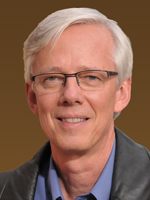 Steve
Wille, is an experienced information technology executive
having worked for large corporations in many roles including
software development, project manger, director of application
development, vice president of corporate information systems,
and senior vice president of a business division. He is affiliate faculty at Regis Unversity where he deveoped a graduate level course in Agile Development which he teaches.. Steve
Wille, is an experienced information technology executive
having worked for large corporations in many roles including
software development, project manger, director of application
development, vice president of corporate information systems,
and senior vice president of a business division. He is affiliate faculty at Regis Unversity where he deveoped a graduate level course in Agile Development which he teaches..
His book, Colorful
Leadership, focuses on three perspectives of project
management, people, process, and innovation. He has written and
facilitated workshops on project management, business analysis,
high performance project teams, and
constructive conflict.
Steve is a PMP (Project Management Professional) and has
developed multiple large information technology systems from the
ground up.
Steve is active in the Colorado IT community
as a board member of SIM
(Society for Information Management, president of RMIMA
(Rocky Mountain Information Management Association), and an
active member of Mile High PMI (Project Management Institute).
He serves on the Regis University IT advisory board.
His MBA is from
Regis University and his
BSBA is from the University of
Denver.
Linkedin: www.linkedin.com/in/coloradowille/ |